What is hypnosis?
Facts Not Fiction
You asked: How? Why? When? Here you go...
Will I lose control?
No. You hear everything, you can stop at any time, and nothing happens that you do not agree to. All hypnosis is self-hypnosis. You do not lose control in trance; you learn to use it.
What if you do not bring me out?
Nothing bad. The worst case is that you drift into a nap and wake up the ordinary way. In every session I bring you back gently, and you can bring yourself back whenever you choose.
Is it safe?
Done well, hypnosis is gentle, and the usual worst outcome is that nothing changes. It is training, not medical care. If you are under a provider's care for what you want to work on, I need their written referral first.
How long does it last?
It depends on the person. Dr. Spiegel puts it plainly: for some people, one session is enough. In his research, about one in four smokers who had a single session of hypnosis had still not smoked two years later (Spiegel and colleagues, American Journal of Psychiatry, 1993). Others need a refresher, and that is normal. Why it lasts: you are not borrowing a feeling from me, you are learning a skill. Once you have felt your mind shift, you know the way back, and you can use it any time you need it. His research found that five minutes of practice a day lowered people’s average breathing rate by about one breath a minute. When you would want more: when the stakes go up, when life adds pressure, or when you are ready to go further. Think of me as your personal trainer for the brain. Just like a good coach, as you get stronger, I take you further.
Can hypnosis recover lost memories?
That is not something I do. Memory is less reliable than most people think, even without hypnosis, and what comes back can be shaped by the questions asked. My work looks forward: the moment you are preparing for, not digging up the past.
Can everyone be hypnotized?
Most people can. Children drift in and out of trance all day; call one in for dinner and see how long it takes. Adults keep plenty of that ability, and it can be measured on a simple zero to ten scale. You do not have to be a special kind of person. You only have to be willing.
What is hypnosis, really?
Think of a movie so good you forget you are watching one. That is the doorway. Hypnosis is three things working together: your attention narrows to one point, everything else fades into the background, and for a while you get to try on a different way of being. Focus, a quieter world around you, and room to change.
What happens in my brain?
Three shifts. The part of you that scans for danger and distraction turns down, so small noises stop pulling you away. The part that plans and directs takes the wheel. And the inner voice that keeps replaying who you think you are gets quieter. That quiet is why change becomes possible. Stanford has watched all three happen live on fMRI, the brain scan that shows which parts of the brain are working hardest from moment to moment.
Does the voice really matter?
It does. Some voices pull you in and some push you away. That is why the first thing I send you is a free recording in my voice, so you can decide for yourself before we ever meet.
Can hypnosis make me perform better?
Yes, and it is the work I love most. Stanford tells the story of swimmers who were faster in practice than in meets. In practice they stayed with their own bodies; in meets they watched the lanes beside them. Once they trained themselves to stay with their own stroke, the meet times came down. That is the skill I train: attention that stays where you put it.
Can it help with a fear like flying?
It can, and the method is simple. Instead of fighting the seat, you float with the plane. You treat the plane as an extension of your body, the same way a bike or a car is. And you learn to separate what is possible from what is probable: the picture your mind paints is vivid, but vivid is not the same as likely.
How do you help someone drop a habit?
I work on what you are for, not what you are against. Tell a mind not to think of a purple elephant and a purple elephant is all it sees. So we build something that feels good from the first session: respect for your own body, and a cue that serves you instead of the old one.
Zoom or in person: which is better?
For one person, Zoom. You are already in the place where you feel safest, so your body settles faster, and the change happens where you live, not in a room you will never see again. No drive there, no drive home. For a group of two or more, a team, a family, an office or a barn full of riders, in person is better. Everyone hears the same voice at the same moment and the group settles together. That is when I come to you.
Where should I be for a Zoom session?
Don’t trust me. Trust yourself. Where do you feel safest? Your favorite chair, your bedroom, your office with the door closed, or your car, parked with the engine off. Never while driving. Pick the place where you would take a nap without thinking twice.
Do I really need headphones?
Yes. They are the one thing not to skip. My voice goes straight to your ear, so every word comes through clearly, and they shut out most of what is around you: traffic, the TV, a barking dog, an office. Fewer interruptions means you go deeper and stay there longer. Any pair works, earbuds or over-ear, wired or wireless.
What screen should I use?
The bigger, the better. A laptop, a desktop or a flat-screen TV is best, and a tablet is the smallest that works well. Avoid a phone if you can: the screen is tiny, it is harder to lock in, and calls and texts are one tap away. Set your screen on something steady instead of holding it.
I’m busy. Can this fit my day?
Yes. Sessions start at thirty minutes, from home, the office or your parked car. Give yourself a few minutes afterward before you drive, fly or jump into your next thing.
What if the call drops?
Nothing bad happens. You come back to full awareness on your own, like waking from a nap. Rejoin the same link, or call (406) 404‑6988, and we pick up where we left off.
I’m not good with technology.
If you can open a link, you can do this. Charge your device, put your headphones in, and open the Zoom link a few minutes early so nothing is rushed.
Is this NLP?
No. NLP works on language patterns. This works on your state: a custom visual, music with a focus rhythm built in, and my voice, designed to bring you into deep focus so you can rehearse what you want inside it. And you don’t have to take my word for it: if you wear a Muse, you see what your own brain did.
What do you actually teach?
How to go from the thermometer to the thermostat. A thermometer reacts: the pressure goes up and it goes up, the pressure drops and it drops. Most people live that way, their stress and cortisol rising and falling with whatever happens. A thermostat sets the temperature and holds it. I train you to be the thermostat: to set your state and keep it there, through focus, brain training, meditation and hypnosis.
Several of these answers draw on Dr. David Spiegel, Stanford Medicine, in conversation on StarTalk and with Dan Harris. Dr. Spiegel and Stanford Medicine are quoted from public sources only and are not affiliated with HEKA TRANCE-formations.
In the words of the ones who shaped it.
Not the Hollywood kind. No swinging watch, no one losing control. Hypnosis is older than its name. In 1779 Franz Anton Mesmer, the man the word “mesmerize” comes from, called it animal magnetism and credited an invisible fluid. In 1784 a French royal commission that included Benjamin Franklin tested his claims and found the effects came from imagination, not magnetism. In 1819 Abbé Faria placed the power where it belongs: in the person receiving it, not the one giving it.
In 1843 the Scottish surgeon James Braid gave it the name we still use and tied it to focused attention. Bernheim and the school at Nancy made suggestion its engine; Émile Coué turned it inward as autosuggestion. In the twentieth century Clark Hull brought it into the laboratory, Dave Elman taught it to physicians and dentists, and Milton Erickson made it conversational: a story told so well the listener goes somewhere. Today it is studied at Stanford and defined by the American Psychological Association.
What never changed is the mechanism: focused attention, and a mind willing to accept an idea.
A responsive influence exists between the heavenly bodies, the earth, and animated bodies.
Franz Anton Mesmer, the source of “mesmerize,” Mémoire sur la découverte du magnétisme animal, 1779Believe and will.
Marquis de Puységur, 1784 (“Croyez & voulez”)A peculiar condition of the nervous system, induced by a fixed and abstracted attention of the mental and visual eye, on one object, not of an exciting nature.
James Braid, Neurypnology, 1843I define hypnotism as the induction of a peculiar psychical condition which increases the susceptibility to suggestion.
Hippolyte Bernheim, Suggestive Therapeutics, 1886The implanting of an idea in oneself by oneself.
Émile Coué, on autosuggestion, Self Mastery Through Conscious Autosuggestion, 1922The essence of hypnosis lies in the fact of change in suggestibility.
Clark L. Hull, Hypnosis and Suggestibility, 1933A state of mind in which the critical faculty of the human is bypassed, and selective thinking established.
Dave Elman, Hypnotherapy, 1964A state of increased awareness and responsiveness to ideas.
Milton H. Erickson, Collected Papers, Vol. IVA focused experience of attentional absorption that invites people to respond experientially on multiple levels in order to amplify and utilize their personal resources in a goal‑directed fashion.
Michael Yapko, TranceworkA natural state of mind with special identifying characteristics.
Gil Boyne, Transforming Therapy, 1985All hypnosis is self‑hypnosis.
Charles Tebbetts, quoted in C. Roy Hunter, The Art of HypnosisA state of highly focused attention.
David Spiegel, MD, Stanford MedicineA state of consciousness involving focused attention and reduced peripheral awareness characterized by an enhanced capacity for response to suggestion.
American Psychological Association, Division 30, 2014
Different words, one agreement:
focused attention, and a mind ready to accept a new idea.
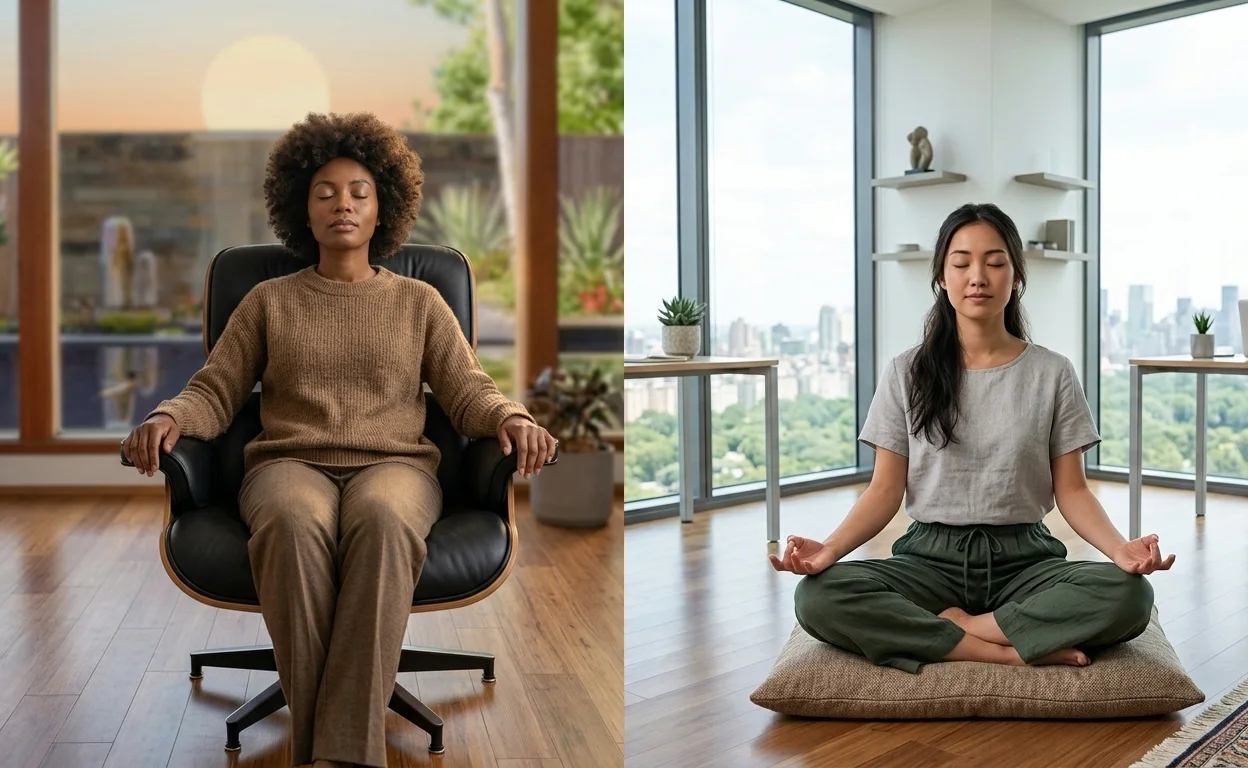
Hypnosis or meditation?
Two different tools, two different jobs.
Aimed at one thing. You settle the body first, then work on a specific problem and change the way you and your body react to it: the problem on one side of an imagined screen, a possible solution on the other. You use it for the moment you named.
Open presence. You are not trying to control or change anything. Thoughts and feelings pass through like a storm going by. You scan the body, you cultivate compassion, and you do it every day to be better and feel better.
Hypnosis is more like an antibiotic and meditation is more like a vitamin.
David Spiegel, MD, Stanford Medicine, on StarTalk
Meditation keeps you well. This practice trains calm to show up when it counts.
The Right Voice
Every word lands somewhere.
Language + timing + technique = art.
Hypnosis runs on language: the words chosen, the pace they arrive at, what is said and when, and what is left unsaid. A word too soon breaks the moment; the right word at the right time opens the door. That is why the voice you go into trance with matters, and why finding the right hypnotist matters as much as finding a good one.
So the first conversation is me listening. Not selling, not scripting. Listening, to learn whether we are the right fit. If we are, you’ll know without either of us saying it. If we aren’t, I’ll tell you, and point you to someone who is.
A private practice · by appointment · grand opening January 1, 2027